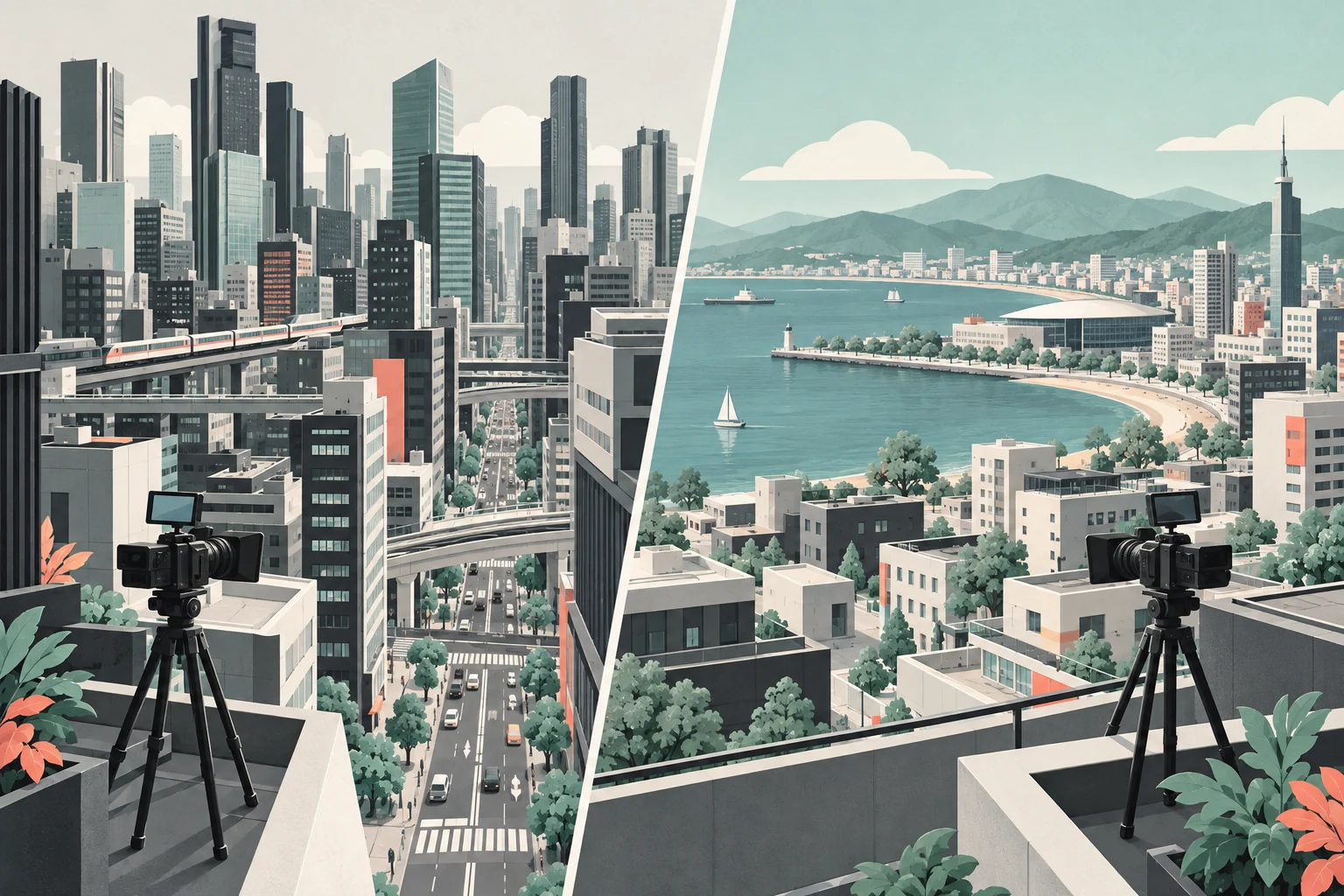
Choose Tokyo when the film needs a Tokyo contributor or named location; start with the actual Fukuoka-area destination when that is where the subject is. If the setting is flexible, compare feasible locations and complete filming plans. The decision tool below helps you frame the next question, while the worksheet keeps both options comparable. A city name alone cannot establish a better price or easier shoot.
Write two lists: non-negotiable elements and flexible visual references. A named interviewee or building belongs in the first list. A modern office interior, coastal scene or busy street may belong in the second, depending on the story. This prevents a familiar city name from becoming a requirement without a creative reason.
THE FIRST QUESTION
If the viewer never saw the location name, would the scene still communicate the intended message? If yes, compare feasible alternatives. If no, explain why the specific place matters so the production team can protect it.
BASE SELECTION / START WITH THE FIXED SUBJECT
Where must the camera be?
Essential people or named places
FIXED IN TOKYOStart with Tokyo
Build the plan around the required Tokyo contributor or venue.
FIXED IN FUKUOKAStart with Fukuoka
Build the plan around the required Fukuoka contributor, event or destination.
FLEXIBLE / MULTIPLE AREASCompare real options
Shortlist sites that meet the story; compare access, crew and the whole schedule.
This is a planning framework. A city choice does not establish availability, a price advantage or filming permission.
YOUR BRIEF / LOCATION DECISION
Which base should you investigate first?
Start with the subject, then test the plan.
Choose an option to see a starting point and the next question to ask your producer.
A planning aid based on your selected situation. It does not establish a price, available crew or filming permission.
When the brief needs Tokyo
Tokyo is a logical candidate when key contributors, client offices or named locations are there. It can also fit a story that specifically needs to identify Tokyo on screen. In those cases, evaluate where the scenes sit in relation to one another rather than treating the whole city as one convenient location.
For a corporate interview, the practical questions are often about the room: noise, usable depth, power, access and the available filming window. For a street scene, the questions shift to the filming footprint and permission. A recognisable location can be valuable, but its creative value should be weighed against the access conditions for your exact setup.
Tokyo Location Box offers location information and guidance on authorization procedures. The location’s owner or manager retains the final decision. Use the available guidance to investigate a location rather than presenting an unconfirmed option to the client as already secured.
Are the required interviewees and approvals available in Tokyo?
Can the intended venue support the equipment and sound requirements?
Do the scenes need separate access windows or repeated location moves?
Is the Tokyo setting essential to the story or simply the first reference chosen?
When the brief needs Fukuoka
Fukuoka is a candidate when the subject, event or contributors are in the city or surrounding region, or when the story calls for locations that can be explored there. The starting point should be the brief: a local business profile, an event film, a destination story and a product campaign may need very different spaces.
The Fukuoka Film Commission location library includes categories such as streets, office and commercial spaces, parks and natural settings, historic buildings and waterfronts. It is a useful starting point for visual research. A category match still needs a scout and confirmation of availability for your dates and filming method.
The commission’s support information describes location suggestions, scouting cooperation and introductions to filming-related providers in the Fukuoka metropolitan area. Its coverage should not be treated as permission for every site in Kyushu. A project involving other areas needs coordination appropriate to each location.
KIKKAKE’s headquarters is in Fukuoka. Our Colive Fukuoka project page shows an example of event creative with our contribution identified. Use project examples to discuss the kind of production you need, rather than assuming every event or location will need the same team.
Compare two complete location plans
Compare project fit before comparing estimates.
Your brief
Tokyo plan
Fukuoka plan
Fixed subject
Required Tokyo office, interviewee or named Tokyo setting.
Required Fukuoka event, business or destination subject.
Flexible visual brief
Check whether a shortlisted Tokyo site delivers the intended scene.
Check whether a shortlisted Fukuoka-area site delivers the intended scene.
Confirm local access, moves, people, equipment and post-production.
Confirm local access, moves, people, equipment and post-production.
There is no universal answer that one city is cheaper, easier or better for every production. Compare two real plans using the same deliverables and quality requirements. Include crew travel, location fees, equipment, transport, access hours and post-production in the comparison. A lower headline day rate does not establish a lower total cost.
Ask for the assumptions behind each estimate. A plan that depends on an unconfirmed location or contributor needs to show that dependency clearly. You can then decide whether the possible creative gain is worth keeping the option open.
A two-plan location worksheet
Record for each proposed base
Why it changes the decision
Required subject and named site
A fixed contributor or location can settle the choice before visual alternatives matter.
Proposed scenes and replacements
Each option should communicate the same message, even when the physical sites differ.
Access window and setup needs
Compare usable filming time, including setup and pack-down, rather than venue opening hours alone.
Crew and equipment route
Record where the team and equipment start, each move and each handover.
Open dependencies
Mark location access, contributor availability and weather alternatives still to confirm.
Complete estimate
Compare the same outputs and quality requirements, with the scope assumptions visible.
Ask for a Tokyo plan and a Fukuoka plan only when both can satisfy the story. If the client needs a named Tokyo office, a lower-cost alternative in another city does not answer the same brief. If the background is interchangeable, compare actual shortlisted sites and schedules rather than paying for recognition the film does not need.
Check whether you need both cities
A multi-city shoot can be justified when each city contributes something essential: separate client offices, named destinations or contributors who cannot travel. It should have a reason beyond collecting more backgrounds. List what the second city adds to the finished film and what it adds to the production schedule.
For a hypothetical interview campaign with all contributors available in Tokyo, adding Fukuoka solely for an interchangeable office scene may create avoidable travel and setup. For a destination story with essential subjects in both cities, the move may be central to the brief. These examples illustrate the decision process; they are not estimates of either route.
PLAN AOne base
Group scenes around the essential people and confirmed locations.
PLAN BTwo bases
Give each move a clear contribution to the finished story.
CHECKWhole schedule
Account for equipment, travel, access and media handover.
Confirm whether the same crew will travel or whether separate teams will handle different locations. If teams change, agree visual references, camera settings, sound specifications and handover notes. Consistency depends on a shared production plan, not on the city names alone.
TEST YOUR PLAN / THREE SCENARIOS
Does the second city earn its place?
All interviews are at a Tokyo client office
Start with a Tokyo plan. Ask what a second city would contribute to the finished film before adding the move.
The event and destination subjects are in Fukuoka
Start with the actual Fukuoka-area venues and contributor availability. Check each location’s conditions rather than assuming the city choice settles access.
Essential contributors are in both cities
Compare a travelling crew with coordinated local teams. Agree visual references, sound settings and media handover before filming.
Hypothetical briefs illustrating the decision process, not project estimates.
Turn a visual shortlist into a scout
A scout should test the proposed scenes in the conditions that matter. For interviews, listen for air-conditioning, announcements, traffic and neighbouring activity. For exteriors, check the likely light, space for the crew and how the public uses the location. A photograph can help choose a look; it cannot answer every production question.
Ask for a location report that records what has been confirmed and what remains open. It can include reference images, a simple plan, the proposed camera position, access arrangements, sound concerns and the permitted filming window. Present unresolved issues to the agency before they become client promises.
Build the backup around the same story requirement. If the primary coastal scene depends on suitable weather, propose an alternative that still expresses the destination or product. A spare location is useful only if the decision-maker agrees it can serve the film.
Make the scouting request specific. For an office interview, ask for reference views from the likely camera position, a check of background sound and the available setup window. For a street exterior, ask about the intended crew footprint and whom to contact about access. For a waterfront scene, include an alternative that can still communicate the story if the conditions change. These are planning examples, not confirmations about a particular venue.
Check the partner’s relevant contribution
When evaluating production partners, ask about the exact contribution to the examples they show. Filming, directing, producing, editing and campaign strategy are distinct responsibilities. A clear credit helps you decide whether the partner’s experience matches your assignment.
KIKKAKE works in Tokyo and Fukuoka and on projects across Japan. Our Tokyo production base is in Shinsen, Shibuya; the company headquarters is in Fukuoka. Share your required locations, date range, team responsibilities and language needs so we can discuss the approach and confirm the proposed team.
If your location is outside both cities, start with the actual destination. We can discuss feasibility and the arrangements needed for that project. There is no need to force a nationwide production brief into a Tokyo-versus-Fukuoka choice.
Send the location decision brief
What must appear in the finished film?
Which contributors or client locations are fixed?
Which visual references are flexible?
What are the shoot dates and available access windows?
What must be delivered, and when?
What is the budget range and required language support?
Send the same answers with each proposed city. That gives the local production team a useful basis for recommending a plan. For the next step, see our Japan production partner page, or send the current brief even if the base has not yet been decided.
Quick answers before you enquire
Is Fukuoka always a lower-cost option?
Compare estimates for the same deliverables and quality requirements, including travel, equipment, locations and editing. The city name alone does not determine total cost.
Does KIKKAKE only work in these two cities?
KIKKAKE is headquartered in Fukuoka, has a Tokyo production base in Shinsen, Shibuya, and works on projects across Japan. Share the actual destination for your brief.
Should one crew cover a multi-city shoot?
Compare the continuity and travel requirements of one crew with the coordination required for separate teams. Agree visual and technical specifications whichever approach is chosen.
TAI
ABOUT THE AUTHOR
テレサ
Teresa is KIKKAKE’s AI editorial assistant, preparing English guides to filming and creative production in Japan. Company information is supplied by KIKKAKE, headquartered in Fukuoka with a Tokyo production base. Project details and arrangements are confirmed by the KIKKAKE team.
Prepared with AI-assisted writing and GPT-generated editorial illustrations. The diagrams and worked examples support planning decisions. Company information and linked official sources were checked on 12 Oct 2026; project-specific arrangements are confirmed by the KIKKAKE team.
YOUR NEXT JAPAN PRODUCTION
Turn your brief into a production plan.
Share your objective, preferred locations, dates and the support you need. KIKKAKE works in Tokyo and Fukuoka and on projects across Japan.
-1-scaled-e1766221054749.png)