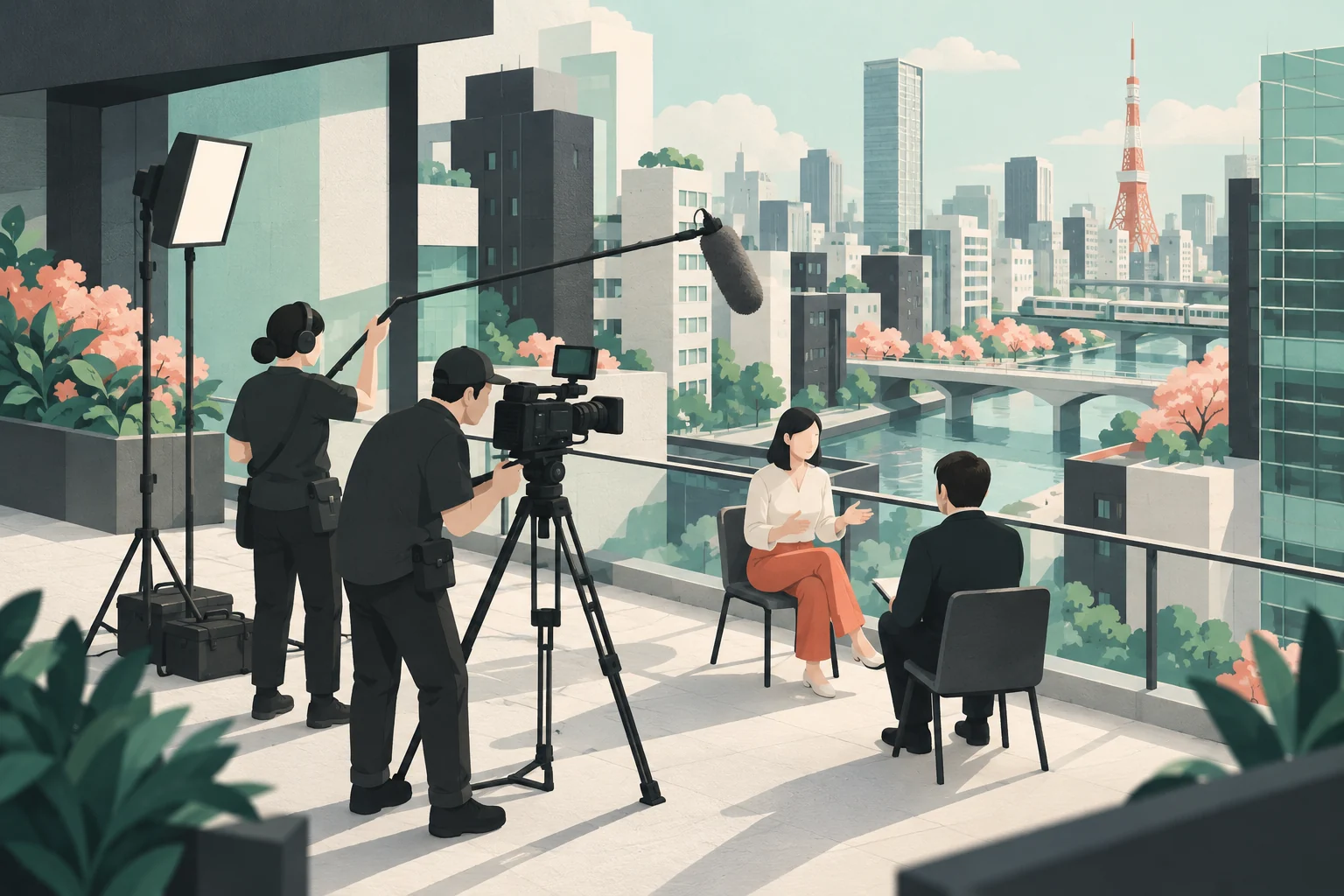
Planning a video shoot in Japan starts with three decisions: what must be filmed, who owns each production task, and what your agency needs delivered. If you already have a director or editor, make that boundary clear before booking a local crew. This guide gives overseas agencies a responsibility worksheet, location checks and a sample shoot-day schedule to use before requesting or approving estimates.
Begin with the business objective and the intended audience. Is the film introducing a Japanese destination to overseas travellers, showing a product to customers in Japan, or supporting a global brand launch? The answer shapes the story, contributors, location choices and language. A beautiful shot has limited value if it does not serve the intended message.
01Creative
Objective, audience, story and references.
02Production
Locations, dates, crew and responsibilities.
03Delivery
Formats, languages, approvals and usage.
List the deliverables individually. For example, “one 90-second landscape film and three 20-second vertical edits” is more useful than “a promotional video with social content.” It lets the production team identify scenes that need additional framing, alternative takes or clean backgrounds for text. These are illustrative specifications, not a recommended length for every platform.
PRODUCTION / FIVE CONNECTED DECISIONS
From a brief to usable footage.
01Scope
Audience, story and outputs.
02Locations
Access, sound and permissions.
03Team
Roles, equipment and language.
04Shoot
Schedule, approvals and backup.
05Handover
Media, edits and acceptance.
Set the responsibility and decision-maker at each stage.
Use this worksheet before asking several teams for estimates. Put a named person or “to be proposed” beside each responsibility. A task can be shared, but one person should own the decision. This is a discussion aid, not a description of a fixed KIKKAKE package.
Agency / Japan team: a responsibility worksheet
Decision
Agency supplies or decides
Agree with the Japan team
Creative direction
Objective, references, script status and the client approver.
Who directs scenes, and who can approve a change during filming?
People on camera
Contributor names, availability and interview intent.
Who schedules contributors and handles on-set communication?
Locations
Which sites are essential; which images are only references.
Who scouts, confirms access and records the filming conditions?
Crew & equipment
Any director, crew or equipment your agency brings.
Which local roles and equipment are in the estimate?
Language
Languages for meetings, interviews, direction and feedback.
Who interprets or translates each stage, if required?
Editing & handover
Your editor, output specifications and delivery deadline.
Who checks the transferred media and when is it accepted?
For example, an agency might provide a director, script and editor, while requesting a local filming team and location coordination. A different brief might ask the partner to develop the concept and deliver the finished assets. The camera day can look similar while the preparation, staffing and handover are very different. Make that boundary visible before comparing prices.
Shortlist locations that can work
Separate the visual reference from the physical location. A reference might show a busy night street, a quiet café or a waterfront. Ask whether the exact place is essential or whether another location could create the same effect. That distinction gives the team room to balance the creative aim with access, sound, operating hours and travel.
For each candidate, record the address, owner or manager, desired filming time, number of people, equipment and activity. An interview with lights and a controlled background has different requirements from a short handheld exterior. A scout should answer practical questions: Where can equipment be unloaded? What background noise is present? Where can talent change? Can the scene still work in rain?
OFFICIAL LOCATION SUPPORT
Tokyo Location Box provides location information and guidance on authorization procedures, and liaises with owners or managers. It states that the location owner or manager has the final say. A listing or introduction does not confirm filming access.
Keep one credible alternative for every scene that depends on a difficult location. If an iconic crossing is unavailable, the alternative should still support the story, rather than simply fill a gap in the schedule. Confirm the replacement with the creative decision-maker before the shoot day.
SCOUTING / FOUR CHECKS
A good-looking location still needs a filming plan.
01Access
Owner, permitted area and filming window.
02Sound
Traffic, air-conditioning and neighbouring activity.
03Footprint
Crew, stands, vehicles and equipment unloading.
04Alternative
A replacement that still supports the story.
Use these four checks when assessing a visual reference or scouting a shortlisted location.
Confirm access for the actual filming plan
Treat permissions as a production task with an owner, not as an assumption attached to a location photograph. Send the proposed filming footprint to the relevant manager or authority: exact position, time, crew size, equipment, vehicles and any effect on other users. Ask what approval is needed and what conditions will apply.
Tokyo Location Box’s road-filming guidance distinguishes road use permission from permission to close a street, and advises early consultation for busy locations. Requirements depend on the filming setup and location. Confirm the current procedure with the responsible authority before scheduling a road scene.
For a private venue, clarify the permitted areas, access window, fees, restoration requirements and who can authorize changes. Also discuss how identifiable contributors, artwork, branding and recorded music will be handled for the proposed use. Keep the relevant approvals with the production paperwork so that the editor is not left guessing which footage can be delivered.
Specify the crew and language needs
Start with responsibilities, then choose the people. Who is directing the performance? Who handles camera, lighting, sound, production coordination and media backup? If your agency sends a director or producer to Japan, specify how their responsibilities meet those of the local team. A short role list helps avoid duplicate bookings and missing tasks.
Language requirements need the same level of detail. State which discussions will happen in English, which contributors will speak Japanese, and whether interpretation or translation is required. A bilingual briefing document, an interpreter for an interview and English communication across an entire crew are different arrangements. Confirm the approach rather than assuming that one contact person covers every situation.
Name the person who can approve creative changes on set.
Agree how questions from the Japan team will reach the overseas decision-maker.
Confirm the language of call sheets, scripts and interview questions.
Share pronunciation, brand wording and translation requirements before filming.
KIKKAKE welcomes English enquiries. Meeting and on-set language arrangements are agreed for each project, alongside the production scope.
Build a usable shoot-day schedule
A shoot schedule should show more than the time the camera is rolling. Include load-in, setup, contributor preparation, sound checks, location moves, breaks and pack-down. Check access times against the schedule: a venue available from 10:00 does not automatically allow equipment setup at 08:00.
Ask the local team to assess moves with the actual equipment and people involved. A route that looks simple on a map can still require loading, parking and access coordination at both ends. Grouping scenes by practical location can protect interview time and reduce repeated setup.
ILLUSTRATIVE PLANNING EXAMPLE
For a brand interview and three social clips at one office, agree the interview first, then list the additional close-ups, demonstrations and vertical takes. Schedule those explicitly. Do not assume that every social edit can be created from the interview footage alone.
For outdoor scenes, define a weather decision point and an agreed alternative. For overseas approvals, write down the decision time in both time zones. This is particularly useful when the people who must approve a change are not available during the Japanese shoot day.
WORKED EXAMPLE / 09:00–17:00
An 8-hour shoot is more than camera time.
3.5hInterview + B-roll slots
4.5hSetup, reset, break + handover
09:0013:0017:00
Setup & sound checks09:00–10:3090 min
Interviews10:30–12:30120 min
Break12:30–13:3060 min
Reset / change setup13:30–14:3060 min
B-roll14:30–16:0090 min
Pack-down & handover16:00–17:0060 min
Illustrative single-location schedule. Adapt the time slots, access windows and breaks with your producer; outdoor and multi-location shoots need their own plan.
Compare the scope behind each quote
A useful estimate makes the scope visible. Request separate information for pre-production, shoot days, equipment, locations, travel and accommodation, post-production and any language support. Ask which items are confirmed and which remain assumptions. You can then see whether a change in scope affects the crew, schedule or final deliverables.
Compare the same brief across proposals. A camera-only quotation cannot be fairly compared with a quotation that includes producing, location coordination and editing. Discuss the budget range early so that the team can propose a workable approach instead of developing a plan that cannot be commissioned.
Agree how additional work will be approved. Examples include extra shoot hours, another location, additional edits or a new language version. Confirm payment terms, the estimate currency and the validity of the proposal directly with the production partner; this guide does not set project prices.
Compare the scope before comparing the total
Ask about
What a clear response should show
Preparation
Scouting, scheduling and location coordination included or excluded.
Shoot day
Roles, equipment, working window and how extra time is approved.
Locations & moves
Which sites are confirmed, allowances still open and transport assumptions.
Post-production
Editor, outputs, review stages, subtitles and additional versions.
Handover
Raw footage or project files requested; transfer and retention arrangements.
A useful follow-up is: “Are both estimates based on the same locations, working window, outputs and handover?” Resolve different assumptions before choosing the lower figure. If one response still depends on an unconfirmed venue, compare it as a provisional plan rather than treating it as the same commitment.
Agree editing and media handover
Before filming, agree who edits and what the editor needs. If your agency handles post-production, clarify camera settings, sound recording, folder structure, transfer method and any reference stills or notes. If the Japan team edits, confirm the first-cut date, feedback process and the person who consolidates comments.
Make an output list that covers aspect ratio, resolution, audio, subtitles, graphics and language versions. Specify whether you need a clean master without subtitles or music, separate audio elements, still images, raw footage or project files. Their inclusion and transfer conditions should be agreed, rather than assumed.
Set a plan for media backup, retention and final handover. Ask when transferred files will be checked and when approval will be recorded. A clear finish line helps both teams know which materials have been accepted and whether further changes are additional work.
Take the next step with a clear brief
Brand, objective and target audience.
Creative references, script or the current concept.
Preferred locations, date range and flexibility.
Your team’s responsibilities and the support you need.
Deliverables, language versions and intended use.
Budget range, first-cut deadline and final approval date.
Meeting, interview and on-set language requirements.
If some decisions are still open, label them as open. A producer can respond more usefully to “Tokyo or Fukuoka, location to be proposed” than to an apparently fixed plan that changes after the estimate. The first enquiry does not need to be perfect; it needs to make the current assumptions visible.
KIKKAKE is headquartered in Fukuoka, with a production base in Tokyo, and works on projects across Japan. See our approach for overseas agencies and share the part of your production you would like us to handle.
Quick answers before you enquire
Can we assume a popular location is available?
Confirm the actual filming setup and date with the location manager or relevant authority. A visual reference or location listing is a starting point for enquiries.
What should be agreed about English communication?
Specify meetings, interview questions, on-set direction, interpretation and translated deliverables separately. KIKKAKE agrees these arrangements for each project.
What can we send before the concept is final?
Send the objective, references, preferred dates, likely outputs, budget range and open questions. Mark undecided items clearly so the team can develop a realistic proposal.
TAI
ABOUT THE AUTHOR
テレサ
Teresa is KIKKAKE’s AI editorial assistant, preparing English guides to filming and creative production in Japan. Company information is supplied by KIKKAKE, headquartered in Fukuoka with a Tokyo production base. Project details and arrangements are confirmed by the KIKKAKE team.
Prepared with AI-assisted writing and GPT-generated editorial illustrations. The diagrams and worked examples support planning decisions. Company information and linked official sources were checked on 12 Oct 2026; project-specific arrangements are confirmed by the KIKKAKE team.
YOUR NEXT JAPAN PRODUCTION
Turn your brief into a production plan.
Share your objective, preferred locations, dates and the support you need. KIKKAKE works in Tokyo and Fukuoka and on projects across Japan.
-1-scaled-e1766221054749.png)